DUSP Undergraduate Course Planning Information

2026-2027 Course Offerings

DUSP Course Descriptions

Current Schedule of Classes

Find this year's course offerings in the DUSP Course Offerings.

Learn more about the courses DUSP offers in the UCSD Catalog.

Find UC San Diego's current schedule of classes on the Triton Student System (TSS).

Winter 2027 Special Course Offerings

USP 142A: Urban Challenges: Homelessness in San Diego
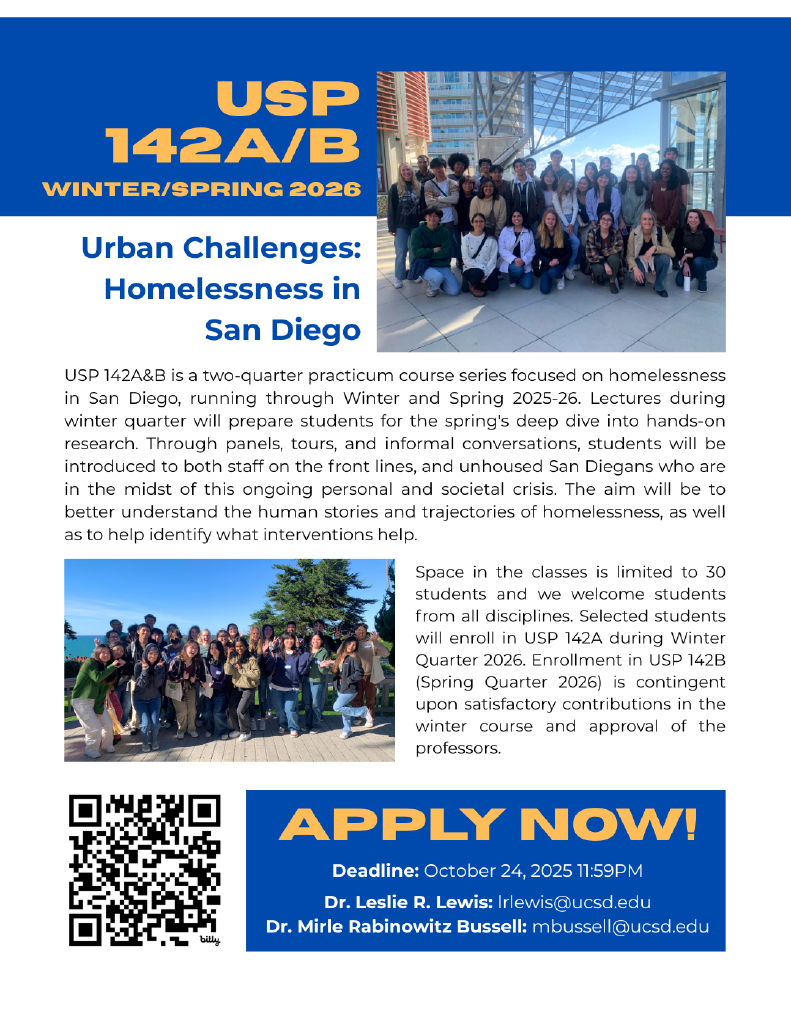
 USP 142 Winter-Spring 2027 flyer featuring past students during fieldwork. Text description: USP 142A&B is a two-quarter practicum course series focused on homelessness in San Diego, running though Winter and Spring 2026-27. Lectures during winter quarter will prepare students for the spring's deep dive into hands-on research. Through panels, tours, and informal conversation, students will be introduced to both staff on the front lines, and unhoused San Diegans who are in the midst of this ongoing personal and societal crisis. The aim will be to better understand the human stories and trajectories of homelessness, as well as help identify what interventions help. Space in the classes is limited to 30 students and we welcome students from all disciplines. Selected students will enroll in USP 142A during Winter Quarter 2027. Entrollment in USP 14B (Spring Quarter 2027) is contingent upon satisfactory contributions in the winter course and approval of the professors. Apply Now (by scanning the QR code)! Deadline: October 30th, 2026, 11:59pm. Contact Dr. Mirle Rabinowitz Bussell: mbussell@ucsd.edu

USP 165A: Advanced Special Topics in Housing: Historic Preservation

USP 165A Winter 2027 flyer featuring murals and the Old Town San Diego sign. Text description: This course offers an overview of the history, philosophies, and professional techniques of historic preservation. Design and aesthetics, laws and regulations, politics, economic forces, and sociocultural factors will be analyzed to chart the ongoing development of the field as an often-contested component of planning and policy. Rooted in a global context, the course will focus on cultural heritage management in the U.S. and particularly the American West. Meeting Times: Tues + Thurs 12:30-1:50pm. Instructor: Caroline Collins, Urban Studies and Planning Assistant Professor

Why do societies seek to preserve histories in built environments? What role does historic preservation play in the development, growth, and culture of cities? Do preservation efforts prevent progress? Who determines what is historically significant to communities and regions? This advanced level course offers an overview of the history, philosophies, and professional techniques of historic preservation. Design and aesthetics, laws and regulations, politics, economic forces, and sociocultural factors will be analyzed to chart the ongoing development of the field as an often-contested component of planning and policy. Rooted in a global context, the course will focus on cultural heritage management in the U.S. and particularly the American West.


USP 165D: Advanced Special Topics in Urban Design and Land Use: A History of the American Univer-city

USP 165D Winter 2027 flyer featuring close-up images of two universities. Text description: What is the history of Universities' relationship to the American city? How have Universities designed towns and built cities? Come and explore case studies and participate in a hands-on approach to History. Meeting Room: CENTR 205. Meeting Times: Mon + Weds 5-6:20pm. Professor: Guadalupe Garcia, Department of Urban Studies and Planning.

What is the history of the University’s relationship to American towns and cities? How have universities designed towns, built cities, and transformed the communities around them while also producing racialized geographies through land acquisition, displacement, segregation, and labor? This course explores the history of American universities through the lens of land use and urban development from the eighteenth century through the present day. Tracing a historical arc, the course highlights the importance of the university in contemporary struggles over land and property and the ways in which urban design influences university-community relations. Students will engage course themes through lecture, discussion, and applied primary research.